
How to Search Hays County Court Records
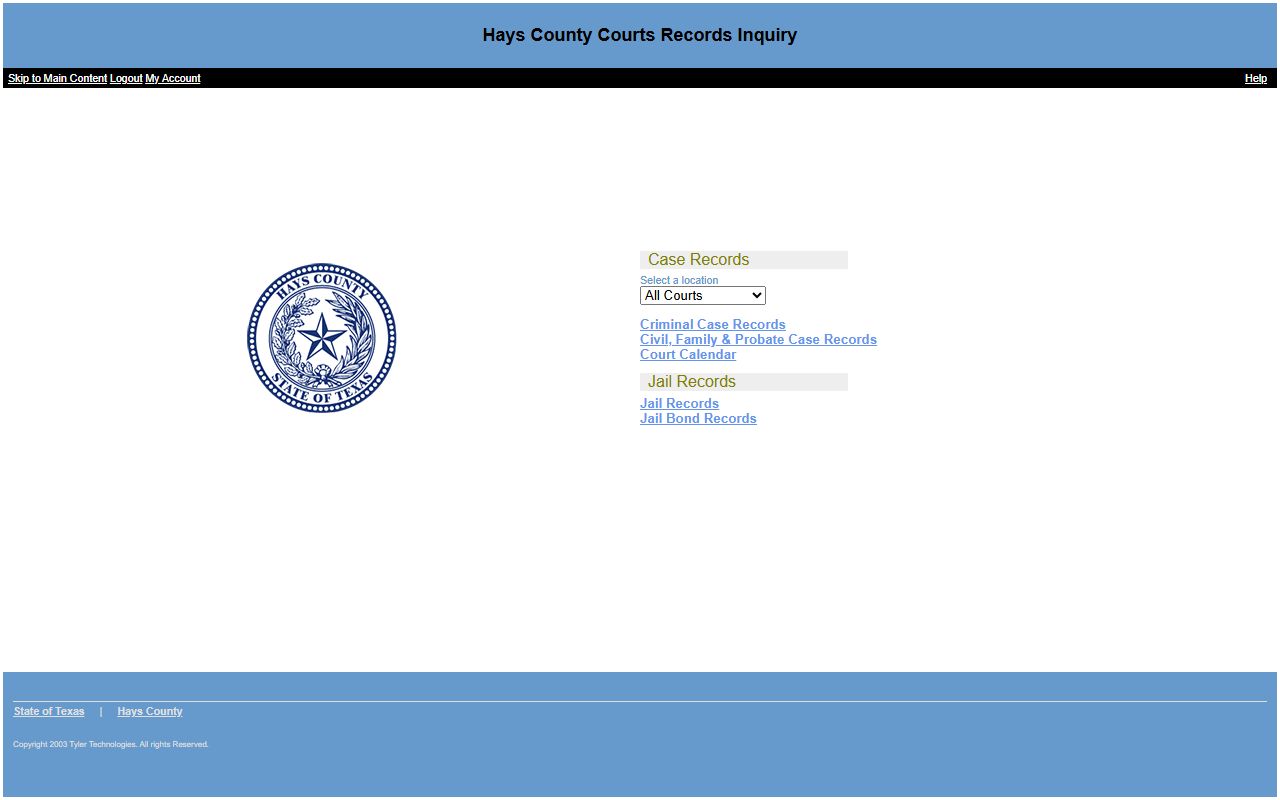
The main place to look is Hays County Odyssey Public Access. The launch page is titled "Hays County Courts Records Inquiry." It is free to open, and it groups searches into two areas. Case Records covers criminal, civil, family, and probate files. Jail Records covers people booked into the county jail and their bond entries. You can search by party name or by case number. A name search is free.
Before you start, gather a few details. The full name helps. A date of birth narrows the results. A cause number, if you have one, takes you straight to the file. The District Clerk page says a free name search returns parties, cause number, case type, filing date, case summary, and, when it applies, the bond company and disposition date.
The official portal sits at the county's public access domain. The launch screen lets you pick a court location before you run a search.
Here is the simple way to run a Hays County court records search online:
- Open the Hays County Odyssey Public Access launch page.
- Choose Criminal Case Records, or Civil, Family & Probate Case Records, or the Court Calendar.
- Pick the court location, then enter a last name and first name, or a case number.
- Add a date of birth or a date range to trim the list.
- Open the case summary, then read the parties, filing date, and disposition.
- Order a certified copy from the clerk if you need one for legal use.
The launch screen below is the same one county staff point to for both court and jail records.
If you would rather have staff run the search, the District Clerk will check civil and criminal records for the past 10 years for a small per-name fee. The county also posts plain instructions on its records page.
The District Clerk records page, shown here, walks through the online portal, the copy fees, and the email quote process for documents.
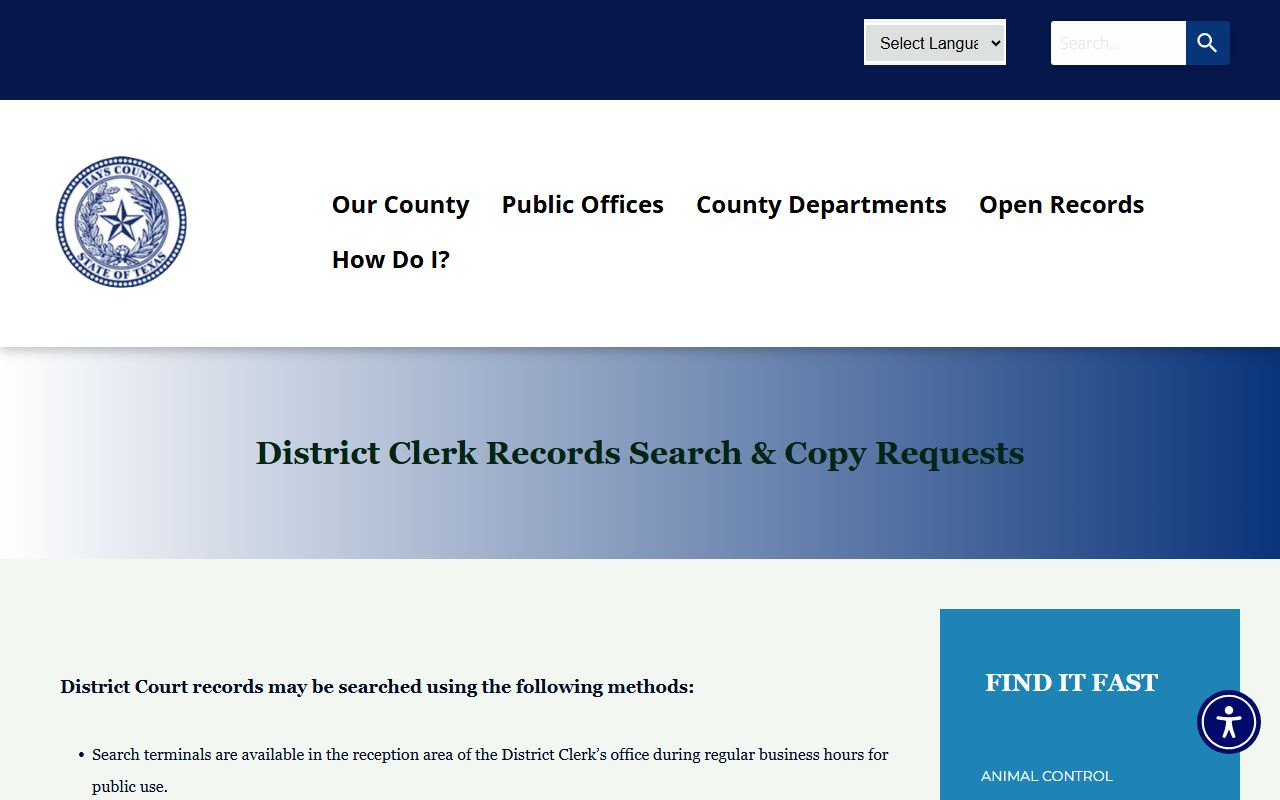
You can read those instructions in full on the District Clerk records search page.
See the Hays County court records page for the full search-field tables and a deeper walkthrough.
The Hays County Judicial System
Texas uses several trial courts, and Hays County has most of them. District courts are the main trial courts. They hear felonies, divorce and family law, and large civil cases. County Courts at Law hear misdemeanors, probate, guardianship, mental health, and mid-size civil disputes. Justice of the Peace courts handle fine-only offenses, small claims, evictions, and traffic tickets. Municipal courts deal with city ordinance and Class C matters inside city limits.
Appeals from the district and county courts go up to the Texas Courts of Appeals. The Supreme Court of Texas is the top civil court, and the Texas Court of Criminal Appeals is the top criminal court. So a case can climb several rungs before it ends.
Case flow: Justice Court › County Court at Law › District Court › Texas Courts of Appeals
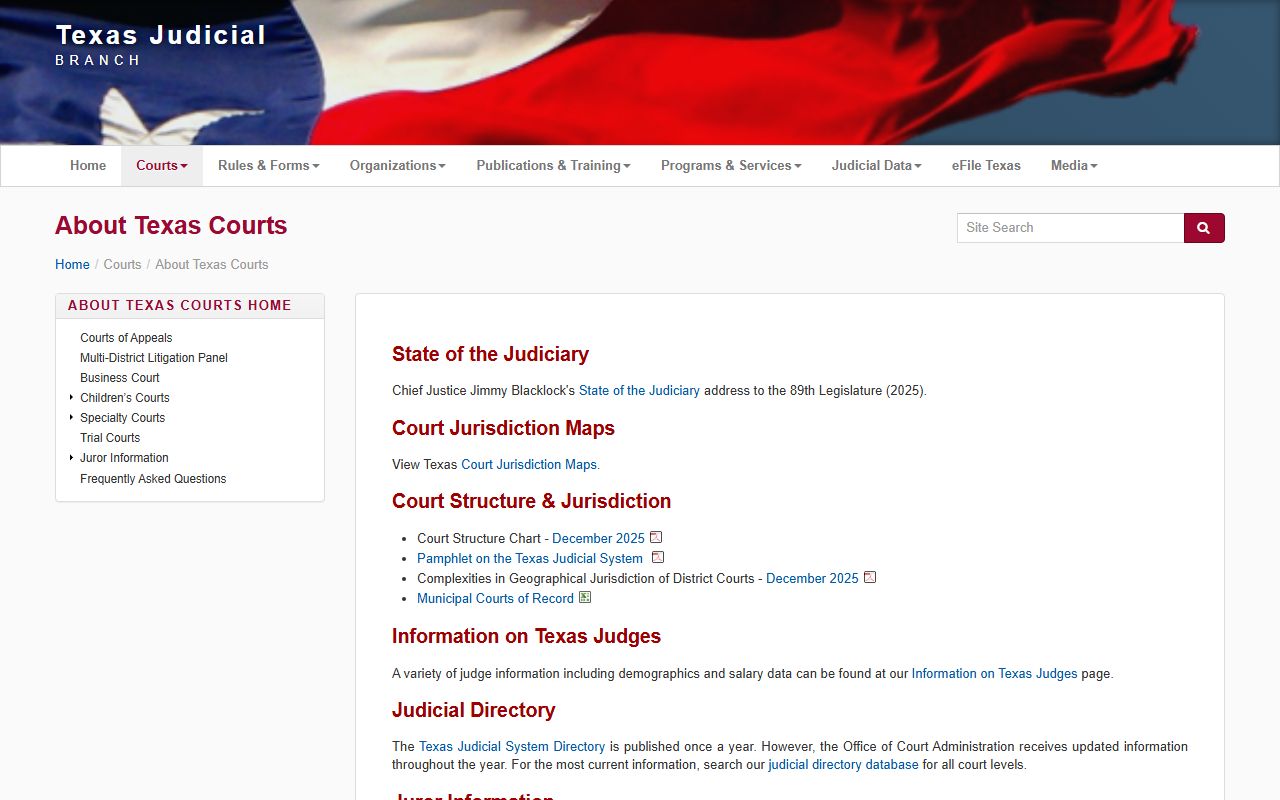
This overview of the Texas court structure, published by the state's judicial branch, shows how the trial courts and appeals courts line up.
You can read the state's own breakdown on the Texas Judicial Branch site.
The table sums up which Hays County court hears which kind of case.
| Court | Jurisdiction | Case Types |
|---|---|---|
| District Court | General trial court | Felonies, divorce, family, large civil |
| County Court at Law | County trial court | Misdemeanors, probate, guardianship, mental health, civil $10,000 to $250,000 |
| Justice of the Peace | Precinct court | Fine-only offenses, small claims, evictions, traffic |
| Municipal Court | City court | City ordinance and Class C fine-only cases |
Read more on the Hays County District Court and County Courts at Law pages.
Hays County Courthouses
Hays County keeps its court offices in one spot. The Hays County Government Center at 712 S. Stagecoach Trail in San Marcos holds the District Clerk, the County Clerk, the district courts, and the District Attorney. Justice of the Peace 1-1 and 1-2 sit in the same building. That makes one address the hub for most record requests, even when the County Clerk runs substations in Kyle, Wimberley, and Dripping Springs.
The District Clerk office page names Amanda K. Calvert and lists the Suite 2211 location and the records search tools.
The District Clerk page is the place to start for district court files; the County Clerk handles county court, probate, and vital records.
Hays County District Clerk
Suite 2211, 712 S. Stagecoach Trail
San Marcos, TX 78666
512-393-7660
Mon-Fri lobby 8:00 a.m. to 4:00 p.m.
Hays County Clerk
Suite 2008, 712 S. Stagecoach Trail
San Marcos, TX 78666
512-393-7330
Mon-Fri 8:00 a.m. to 4:30 p.m.
Hays County District Court
Suite 3240, 712 S. Stagecoach Trail
San Marcos, TX 78666
512-393-7700
Mon-Fri 8:00 a.m. to 5:00 p.m.
Types of Court Records Available in Hays County
Hays County court records fall into a few broad groups. Each group sits with a different court and a different clerk. Felony and family files go to the District Clerk. Misdemeanor, probate, and county-court files go to the County Clerk Courts Division. Fine-only and traffic matters live with the justice courts.
The County Clerk Courts Division page, shown below, lists the case types it keeps and gives plain search steps.
You can review the division's own list on the County Clerk Courts Division page.
Fine-only offenses and traffic tickets take a different path. The Justice of the Peace landing page below explains the precinct courts and their jurisdiction.
The county runs seven JP courts; details sit on the Justice of the Peace page and the local justice court page. The main record groups are:
- Criminal records - Felonies sit with the District Clerk; misdemeanors with the County Clerk.
- Civil records - Lawsuits, judgments, and money disputes, split by dollar amount between the courts.
- Family and divorce records - Held by the District Clerk's Office, not the County Clerk.
- Probate records - Wills, estates, and guardianships filed with the County Clerk Courts Division.
- Traffic records - Citations and fine-only cases in the justice and municipal courts.
What Hays County Court Records Show
A court record is built from fields. The header carries the cause number, the case type, the filing date, and the court. The body lists the parties, the events, and the result. The District Clerk confirms that a free name search shows parties, cause number, case type, filing date, case summary, bond company when it applies, and disposition date when it applies.
Most public summaries do not show full documents online. They point you to the file. To read or copy a pleading, you order it from the clerk. The table below maps the common fields.
| Field | What It Shows |
|---|---|
| Case Number | The unique cause number the clerk assigns to the case. |
| Filing Date | The date the case or pleading was filed. |
| Parties | Plaintiff, defendant, petitioner, respondent, and attorneys. |
| Charges / Cause | The offense charged or the claim raised in the suit. |
| Disposition | The outcome, such as dismissed, guilty plea, or judgment. |
| Sentence / Judgment | The penalty or the relief the court ordered. |
Note: Online case summaries are public information, not a full criminal history, so verify key facts with the clerk before you rely on them.
Public Access Laws for Hays County Court Records
Texas treats most government records as open. The Texas Public Information Act, in Government Code Chapter 552, gives the public the right to see records held by a governmental body unless a law makes them confidential. Court case files carry their own court rules on top of that act. Hays County takes public information requests online, by mail, by email, and by fax through its Office of General Counsel.
A handful of statutes shape what you can and cannot see. The callout lists the main ones with a plain-English line each.
Key Statutes:
Texas Government Code § 552.021 - Public information is open during normal business hours.
Texas Government Code § 552.101 - Records made confidential by other law can be withheld.
Texas Government Code § 552.147 - A living person's Social Security number may be redacted.
Clerk copy fees are set locally. The act mostly governs non-court county records, while the courts control access to sealed case files. More detail sits on the Hays County public records page.
Records That Are Restricted or Confidential
Not every file is open. Some records are sealed by statute, and some by court order. Juvenile records are limited under Texas Family Code Chapter 58. Adoption files are confidential under Chapter 162. Mental health records are protected under Health and Safety Code Chapter 611. Each of these stays out of the regular public docket.
Criminal records can also be cleared. Expunction under Code of Criminal Procedure Chapter 55 removes eligible records. An order of nondisclosure under Government Code Chapter 411 hides eligible records from most public searches but does not erase them for all uses. To view a sealed civil file, a person usually must file a motion in the court that holds it and show a legal reason. The clerk cannot lift a seal on its own.
Specialty Courts in Hays County
Hays County runs problem-solving courts that work alongside the regular dockets. The Mental Health Court is overseen by Judge Elaine Brown in County Court at Law #3. It aims to spot defendants who face mental health, substance use, or developmental challenges early, then connect them to treatment, housing, benefits, and counseling. Referrals can come from the jail, attorneys, judges, officers, family members, providers, the District Attorney, or the person themselves.
The County Clerk Courts Division also serves as clerk for the Veterans Court and the Juvenile Court. These courts handle a smaller set of cases with a focus on supervision and services rather than punishment alone. The Mental Health Court page lists a direct phone line and an administrator contact for referrals.
Hays County Sheriff and Jail
The Hays County Sheriff's Office runs the county jail and posts public booking data. Sheriff Anthony Hipolito holds the office for the 2025 to 2028 term. The Sheriff's Office sits at 810 S. Stagecoach Trail in San Marcos, and the jail is at 1307 Uhland Road. The office page links jail records, bond information, a jail population dashboard, the sex offender registry, and crime reports.
The Sheriff's Office page, shown here, is the gateway to most jail and law enforcement tools.
For the full roster and booking search, see the Hays County inmate records page, and check warrant records for outstanding warrants.
Marriage, Divorce, and Probate Records
The County Clerk issues marriage licenses and keeps vital records, while the District Clerk holds divorce files. Probate and guardianship cases are filed with the County Clerk Courts Division. So a couple gets a marriage license from the County Clerk, but a divorce decree comes from the District Clerk. See the marriage and divorce records and probate records pages for the full process.
The County Clerk main page, shown here, names County Clerk Elaine H. Cardenas and lists the Records, Courts, and Commissioners Court divisions.
You can confirm divisions and contact emails on the County Clerk page. A few core probate terms help when you read these files.
- Testator
- A person who makes a valid will.
- Executor
- The person named in a will to settle the estate.
- Conservator
- A person a court names to manage another adult's affairs.
Hays County Court Records Fees
Fees depend on the clerk and the kind of copy. The District Clerk charges for staff searches and for copies of documents in a case. A free name search in the online portal costs nothing. Payment is due before staff run a search or pull copies.
| Item | Amount |
|---|---|
| Electronic copy, first 10 pages | $1.00 |
| Electronic copy, each added page | $0.10 |
| Certified copy per page | $1.00 |
| Embossed seal | $5.00 |
| District Clerk name search (10 years) | $5.00 per name |
The County Clerk sets its own fees for vital records and marriage licenses. Those appear on the County Clerk page.
How to Interpret Hays County Court Records
Court files use shorthand. An arrest is not a conviction. A charge is only an accusation until the court enters a disposition. A guilty plea, a dismissal, or a verdict closes that question. Texas also uses deferred adjudication, where a judge holds off on a finding while the person completes conditions. If they finish, the case may be dismissed.
Watch the disposition line and the dates. A capias is a warrant a court issues, often after a missed setting. A continuance just moves a hearing to a later day. When a code or term is not clear, the clerk's office can explain what it means, though staff cannot give legal advice.
Accuracy and Record Limitations
Online data can lag. Clerks enter events as cases move, but there is a gap between what happens in court and what shows on screen. The County Clerk self-service site warns that its index works like a card catalog and that images may be down during backups. So a clean search does not always prove a clean record.
Note: Always confirm a name, date, or disposition with the clerk who holds the file before you act on what an online search shows.
History of Hays County Courts
Hays County was named for Texas Ranger John Coffee "Jack" Hays, and San Marcos grew up around its springs as the county seat. The County Clerk describes the clerk role as one of the oldest in government. Over time the county pulled its court offices together at the Government Center on Stagecoach Trail, which now houses the clerks, the district courts, and the District Attorney.
The county has grown its court bench, too. The district bench now seats six numbered courts plus associate judges. In March 2021, Hays County launched a public jail population dashboard with the Vera Institute of Justice, a step that put daily jail data in front of residents.
The county's District Court page, shown here, lists those numbered courts and their judges and coordinators.
The full bench and staff contacts appear on the District Court page.
Frequently Asked Questions
Where do I search Hays County court records online?
Use the Hays County Odyssey Public Access portal. The launch page offers Criminal Case Records, Civil, Family & Probate Case Records, a Court Calendar, Jail Records, and Jail Bond Records. The County Clerk Courts Division links the same portal. Skip third-party sites that charge for repackaged public data.
Which clerk handles Hays County divorce records?
The District Clerk. The County Clerk Records Division states plainly that divorces and family court matters are held in the District Clerk's Office. Ask the District Clerk for certified divorce decrees, and use the County Clerk only for marriage, birth, and death records.
How do I find someone in the Hays County Jail?
Open the Odyssey Jail Records search and look up the person by last name and first name, or by booking number. The form also takes booking and release date ranges. To confirm custody, call Jail Records at 512-393-7832, since release status can change fast.
More on the Hays County Court Records FAQ page.