
Getting a Marriage License in Hays County
The Hays County Clerk issues marriage licenses. The Records Division asks couples who can both appear in person to complete an application on the Self-Service portal before they visit. The choice is between a formal marriage application, which has a 72-hour waiting period and a 90-day expiration, and an informal marriage application, used when there will not be a ceremony. After the online step, both applicants visit a County Clerk location to finalize the license.
Each applicant must bring a proper government-issued ID. The page accepts a driver license, a certified copy of a birth certificate, or a valid passport. Hospital birth records do not count. If one applicant cannot appear, an Affidavit of Absent Applicant may be submitted when the license is purchased. Proxy ceremony participation is limited under Texas Family Code Chapter 2 to U.S. armed forces members stationed in another country in support of combat or another military operation.
How to Apply for a Marriage License in Hays County
The steps below match the workflow the County Clerk Records Division publishes. Both applicants need to appear in person at a County Clerk office unless using the remote formal-license process.
- Complete the Self-Service portal application before the visit.
- Pick a formal marriage application or an informal marriage application.
- Bring both applicants to a Hays County Clerk location with government-issued ID.
- Pay the fee in cash or by credit card.
- Wait 72 hours unless the wait is waived by a Twogether in Texas certificate.
- Hold the ceremony before the 90-day expiration date.
- Return or record the license after the ceremony as Texas law requires.
For applicants who cannot both attend in person, Hays County links a virtual appointment for formal marriage licenses through its SeamlessDocs page. That option still requires a ceremony.
Marriage License Application Fields
The Permitium portal start screen gives the public a look at the fields the application uses. Identification upload is required, and payment is part of the workflow. The main start-screen fields are listed below.
| Field / Choice | Required | Notes |
|---|---|---|
| Request type: Birth, Marriage, or Death | Yes | Marriage Certificate is the relevant choice |
| Identification upload | Yes | Texas DSHS requires ID; primary Group A ID forms accepted |
| Delivery / receipt method | Yes | Selected during the application |
| Payment | Yes | Card payment; a nonrefundable service/credit-card fee applies |
Hays County Marriage and Divorce Fees
The County Clerk publishes a clean fee table. Cash or credit card is accepted at the office, and online orders carry a nonrefundable service fee on top of the record price.
| Item | Amount |
|---|---|
| Formal marriage license | $81.00 |
| Twogether in Texas marriage license | $21.00 |
| Out-of-state applicant fee | $100.00 additional if neither applicant proves Texas residency |
| Certified marriage record online | $20.00 per copy |
| Online service / credit-card fee | $5.00 nonrefundable |
| VitalVerify fee on delivery orders | $1.00 |
| License validity | 90 days from issuance |
| Waiting period | 72 hours, waived with Twogether certificate |
Note: A military hostile-fire-zone waiver may waive fees with documentation, per the County Clerk Records Division page.
How to Look Up Hays County Marriage Records
Marriage records live with the County Clerk Records Division. The county uses Permitium for online orders of certified marriage records. The start choice on the portal is "I am requesting a certified Marriage Certificate." Online requests are processed during normal business hours, Monday through Friday from 8:00 a.m. to 4:30 p.m. Orders require ID upload and payment.
The Texas Family Code chapters that frame the marriage process are useful background. Chapter 2 governs marriage license requirements, ID, waiting period, and proxy ceremonies. Spousal inheritance also touches the Estates Code. The Texas wills statute is shown below.
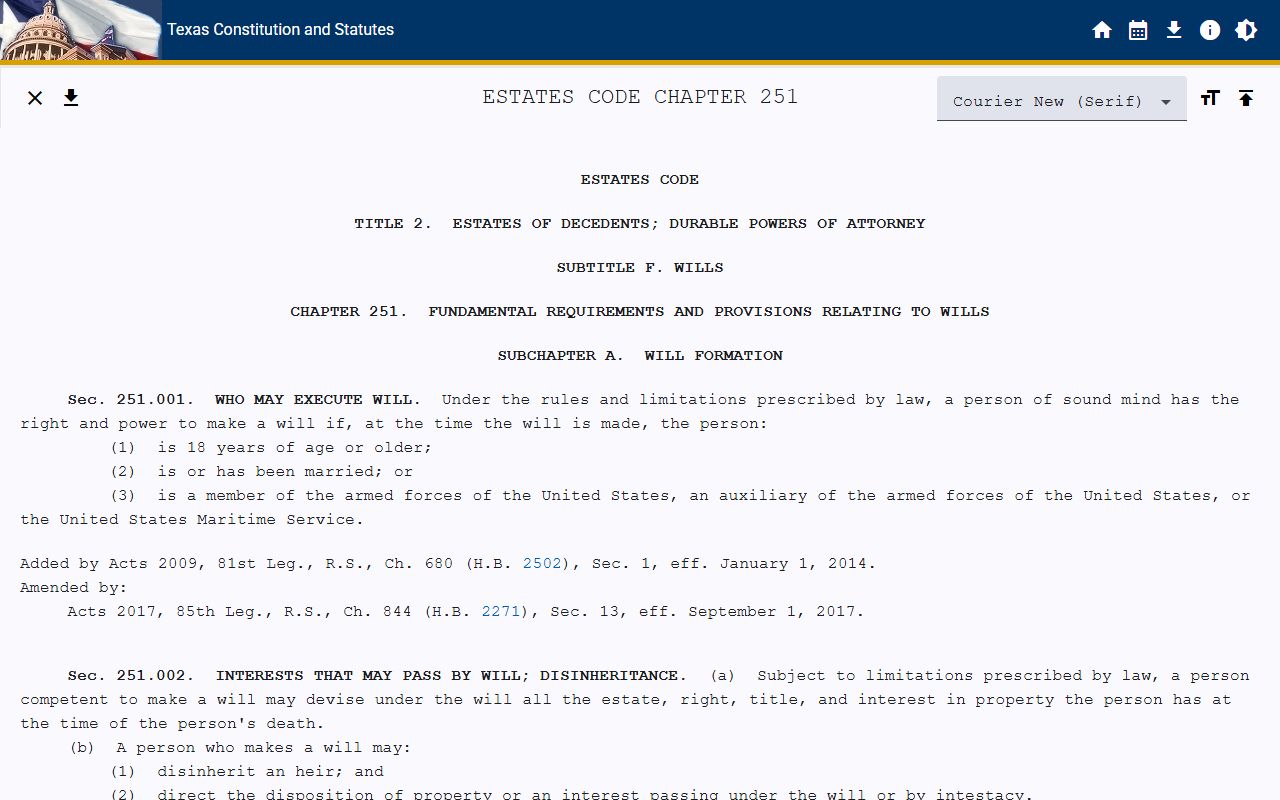
You can read it at Texas Estates Code Chapter 251. The probate-of-wills statute, shown next, covers the procedure when a spouse passes away.
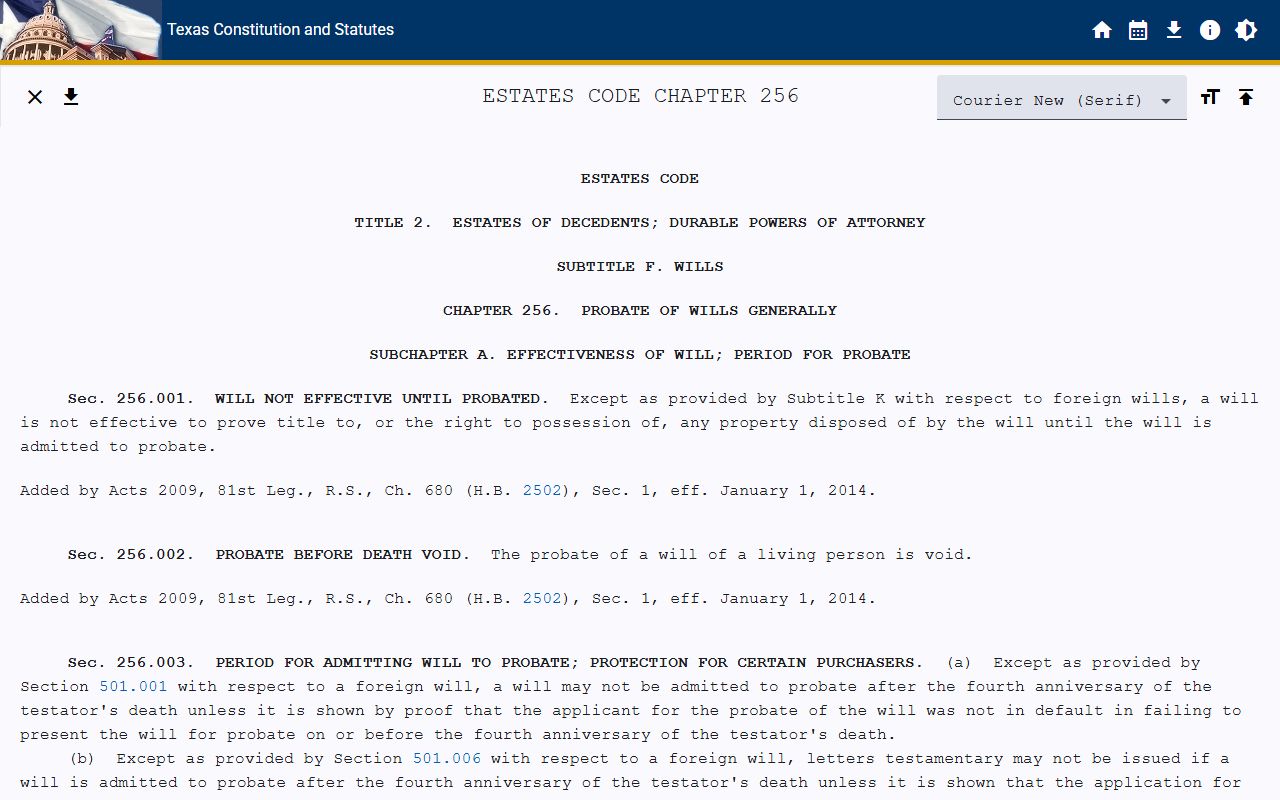
That chapter sits at Texas Estates Code Chapter 256. Both come up when a marriage record is needed for an estate matter.
How to Find Hays County Divorce Records
The County Clerk Records Division states plainly that divorces and family court matters are held in the District Clerk's Office. So a Hays County divorce records search goes through the District Clerk, not the County Clerk. The free Odyssey case search includes the Civil, Family & Probate option, which is the right place to look up a divorce case.
A divorce file includes the petition, citation, answer, motions, orders, child support and custody documents when they apply, and the final decree. Some details are sealed or redacted, including minor children's identifying information, financial account numbers, and any matters the court orders sealed under Rule 76a. For a certified divorce decree copy, request it from the District Clerk by email quote and Certified Payments, not from the County Clerk's vital records portal. See the Hays County District Clerk page for the full request workflow.
Filing a Hays County divorce starts with confirming venue. Texas residency rules require one spouse to have been a state resident for the past six months and a county resident for the past 90 days. The Hays County District Clerk takes new family-law filings. eFileTexas is the state's official e-filing system and is the standard way attorneys and self-represented parties file. The Hays County Law Library helps people who file on their own with research access, e-filing support, and form drafting. Texas Family Code Chapter 6 controls divorce procedure, including grounds, residence, and the standard sixty-day waiting period after the petition is filed.
The cost path for a divorce also splits. The filing fee is paid to the District Clerk at the time of filing, unless the filer submits a Statement of Inability to Afford Payment. A certified decree carries the District Clerk copy fee schedule. A pro se filer should expect to pay a service-of-citation fee in addition to the filing fee, since the respondent must be served unless they waive service.
Getting Certified Copies in Hays County
Certified copies carry an embossed seal and are accepted in legal proceedings. Marriage certified copies are ordered online through Permitium or in person at a County Clerk office. Divorce certified copies come from the District Clerk after an email quote and payment. The District Clerk page says copies or certified copies are mailed within two working days after payment confirmation. Pricing for District Clerk copies is $1.00 for the first 10 pages of an electronic copy, $0.10 per page after that, $1.00 per page for certified copies, and $5.00 for the embossed seal.
Most agencies, banks, and courts will not accept a plain online copy for a name change, an immigration filing, or an estate matter. Plan for a certified copy when the record is going to a government or financial institution. A plain copy is fine for personal records or a family file.
Legal Help for Marriage and Divorce
People who need legal help can use several Texas resources. The State Bar of Texas runs a lawyer referral and information service that connects users to attorneys for paid or reduced-fee consultations.

You can reach it at the State Bar of Texas. For free or low-cost help, the Hays County Law Library, Texas RioGrande Legal Aid, Volunteer Legal Services of Central Texas, and Texas Legal Services Center are useful starting points. The Hays County Law Library, in particular, supports self-represented litigants with research, forms, and e-filing through eFileTexas.
Texas Vital Records and the County Clerk
Most Hays County marriage records can be obtained at the local County Clerk level, so a state-level vital records request is not always needed. For statewide context, Texas vital records are governed under state Department of State Health Services rules, and ID and form requirements are similar to those Hays County uses through Permitium. For a divorce verification rather than a full decree, the state's bureau of vital statistics can confirm whether a divorce was filed in Texas, while the certified decree itself remains a clerk function in the county where the case was filed.