
Hays County Public Records Overview
The Texas Public Information Act sits in Government Code Chapter 552. It applies to governmental bodies, including Hays County offices, and gives the public a right to records unless a law makes them confidential. Court files have their own access rules layered on top of the act, but most non-court county records are open during business hours, with limits for items like Social Security numbers, driver license information, and financial account numbers.
The County Clerk Records Division maintains official public records from 1848 to the present. Those include deeds, deeds of trust, liens, assumed names, cattle brands, and other property and business filings. The Records Division also handles birth, death, and marriage records. So a Hays County public records search may go to the County Clerk, to the District Clerk, or to the Office of General Counsel for a Public Information Act request, depending on the type of record.
The Records Division sits on the County Clerk Records Division page.
How to File a Hays County Public Information Act Request
The Texas Public Information Act lets any person request public information from a governmental body. Hays County accepts requests through several channels, and the process is the same regardless of which method you choose. Use the steps below to put a clean request together.
- Identify the record you want and the office that likely holds it.
- Write a short request that names the record clearly, with dates and parties when possible.
- Submit through GovQA online, by mail or hand delivery to the Office of General Counsel, by email to PIA-Requests@hayscountytx.gov, or by fax to 512-392-6500.
- Wait for the office to confirm receipt and to estimate any fee for staff time, copies, or production.
- Pay the fee in advance if one applies.
- Pick up or receive the record by the method the office offers.
The Office of General Counsel address for mail or hand delivery is 111 East San Antonio Street, Suite 202, San Marcos, Texas 78666. The County Clerk page also links English and Spanish Public Information Act notices for the public.
Hays County PIA Request Form Fields
A clear request avoids back-and-forth. Texas does not require a specific form, but most requests include the items below. Putting all of them in one message helps the office process the request quickly.
| Field | Required | Notes |
|---|---|---|
| Requestor name | Yes | Used for the response and any fee notice |
| Contact: email, phone, or address | Yes | How the office will reach you |
| Description of the record | Yes | Be specific: title, date range, parties, or case number |
| Date range | Helpful | Narrows the search and the fee |
| Preferred format | Helpful | Electronic copy or paper |
| Delivery method | Yes | Email, mail, or pickup |
Hays County Property and Official Public Records
Property records sit on the County Clerk's Self-Service Web portal. The portal disclaimer says the site is a public service, that the index works like a library card catalogue, and that images may be unavailable during backups. Users are asked to try every spelling variation before deciding a record does not exist.
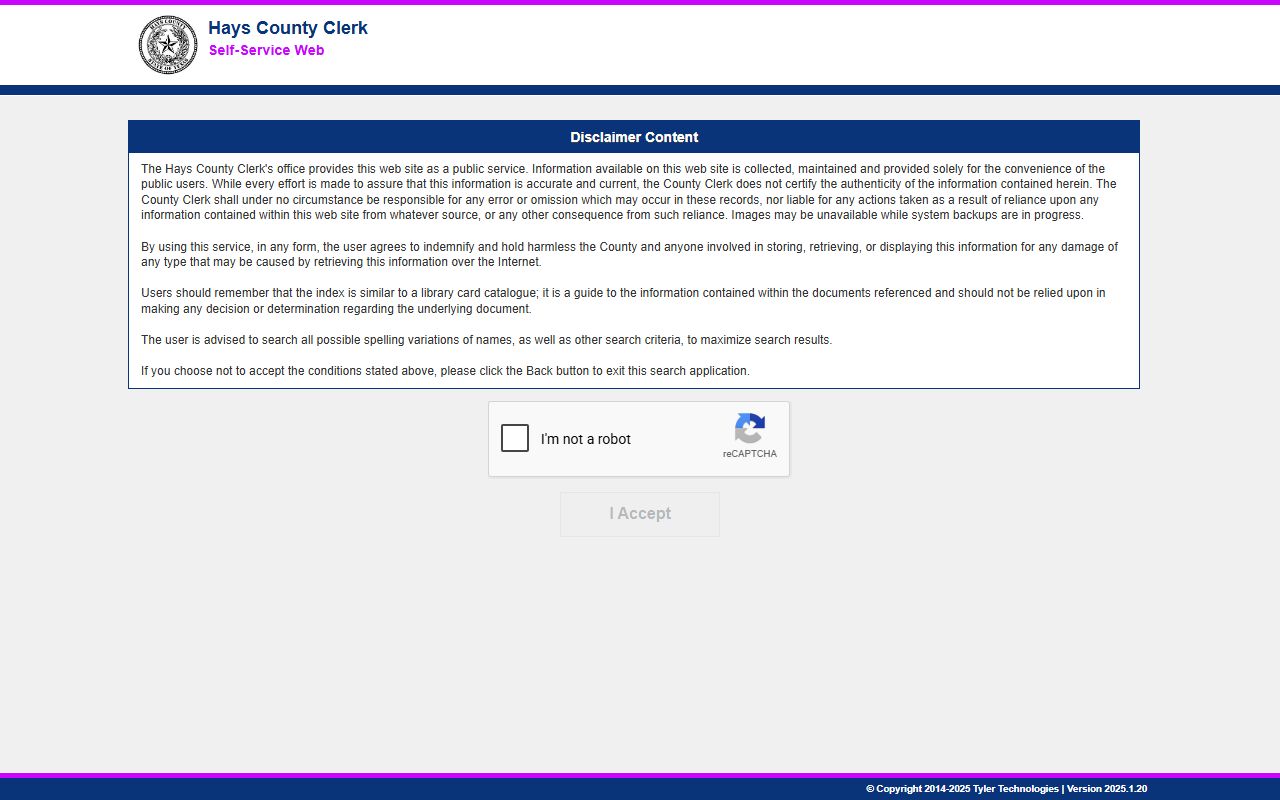
Open it at the County Clerk Self-Service Web. For certified copies of deeds, liens, or other official public records, contact the County Clerk Records Division. The County Clerk also runs a free Fraud Guard alert service that notifies registered users when a document bearing their name is recorded, which is useful against property fraud.
Property records often power a broader Hays County public records search. A real estate buyer or seller may need a deed, a title company may need a lien release, an investor may need a map of recorded easements, and an heir may need a recorded affidavit of heirship. Each of those touches the County Clerk index, and each may need a certified copy from the office. The Records Division accepts in-person filings in Suite 2008, and the substations in Kyle, Wimberley, and Dripping Springs handle many of the same record types during their posted hours.
Hays County Public Records Fees
Fees depend on the office and the kind of copy. The County Clerk Records Division publishes set fees for vital records and basic filings. For court records, the District Clerk fee schedule applies. PIA fees from the Office of General Counsel follow state Attorney General rules for staff time and production. The table below shows the known fees most often relevant to a public records request.
| Item | Amount |
|---|---|
| Assumed name filing | $25.00, plus $0.50 per additional owner |
| Certified birth certificate | $23.00 |
| Certified marriage record online | $20.00 per copy |
| Certified death certificate, first copy | $21.00; additional copies $4.00 each |
| District Clerk electronic copy | $1.00 first 10 pages, $0.10 each after |
| District Clerk certified copy per page | $1.00; embossed seal $5.00 |
| District Clerk staff name search (10 years) | $5.00 per name |
| Online card convenience | 2.3% on County Clerk online payments |
Note: PIA production fees vary, so the Office of General Counsel sends a written estimate before any payment is due on a large request.
Public Access Laws for Hays County
The Texas Public Information Act is the centerpiece. A few sections come up most often in county records work.
Key Statutes:
Texas Government Code § 552.021 - Public information is available during normal business hours.
Texas Government Code § 552.101 - Confidential information protected by other law may be withheld.
Texas Government Code § 552.130 - Texas motor vehicle and driver license information is protected.
Texas Government Code § 552.147 - A living person's Social Security number can be redacted.
If the office denies access, certain disputes can be referred to the Texas Attorney General under the act's rules. Court-record access disputes can also be raised by motion in the court that holds the file.
A few exceptions trip people up. The act's confidentiality umbrella in section 552.101 carries weight when juvenile, mental health, adoption, or victim-protection laws apply. Section 552.108 lets agencies withhold parts of an active law enforcement file. Marriage license application data is protected under section 552.141. Knowing which exception is being raised helps a requester narrow the request or ask the right follow-up question.
Filing Court Records: eFileTexas
Most court filings in Texas go through eFileTexas, the official electronic filing system. The County Clerk and District Clerk link the system from their pages. Attorneys must use eFileTexas, and self-represented filers may use it as well. The Hays County Law Library helps people who file on their own with e-filing support and form drafting.
Open it at eFileTexas. eFiling does not replace a Public Information Act request, since a request asks for existing records, while eFiling submits new pleadings.
Hays County Context for Records Requests
Census data helps put a public records workload in context. The U.S. Census Bureau publishes QuickFacts for every county, including population, household, and business figures. That data is also useful when computing rates such as a jail population per 100,000 residents or a per-capita filing volume.
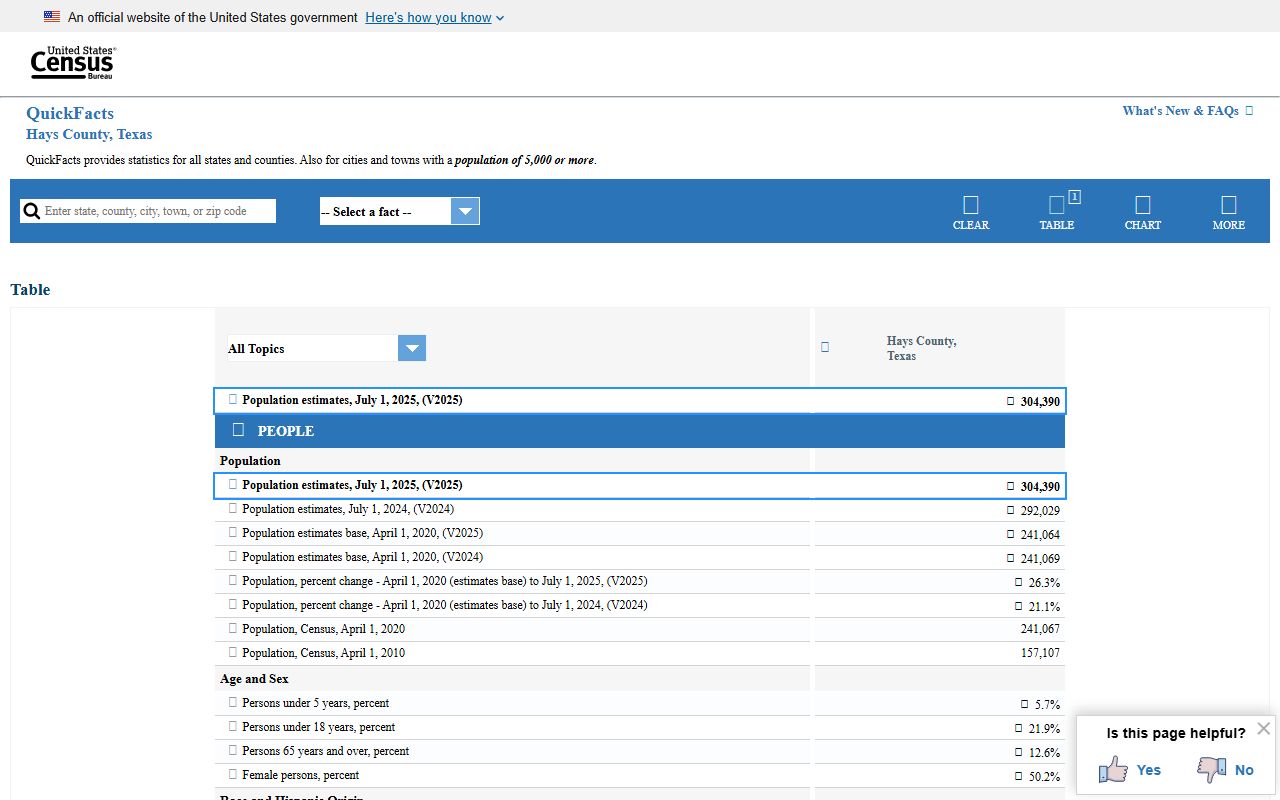
Read the page at Census QuickFacts for Hays County. For property, mail, and government addresses, the county uses 712 S. Stagecoach Trail as the central Government Center address. Foreclosure postings and sales are held at the South Door of that building on the first Tuesday of each month.
Hays County also publishes plain-language PIA guidance in English and Spanish, linked from the County Clerk page. That helps Spanish-speaking residents make a request in the language they prefer, and it sets the same legal standard for response time and fees as a request in English. The county's own Office of General Counsel handles intake for all PIA requests, so a single point of contact reaches every county department.
One more practical note. Records that are not held by Hays County offices, such as Texas Department of Public Safety driver records, federal court files, or state agency licensing records, are not produced through a county PIA request. Those records belong to other agencies and must be requested from them. A county PIA office will say so and often points the requester to the right state or federal source.