
Hays County District Courts Overview
Texas district courts are the trial courts of general jurisdiction. They hear felonies, family-law matters, divorces, and the largest civil cases. In Hays County, six numbered district courts and several associate judges share the docket. The District Court page lists the courts at Suite 3240 of the Government Center, with a main phone of 512-393-7700 and a fax of 512-393-7713. Judge Sherri K. Tibbe of the 453rd District Court serves as the administrative judge.
Hays County also has associate judges who handle high-volume work alongside the numbered courts. Judge Karl Hays sits as a family court associate judge, and Judge Ben Moore serves as a criminal associate judge and magistrate. Court coordinators handle scheduling and contact within each numbered court.
The District Clerk, currently Amanda K. Calvert, is the records office for all of these district courts. Her office files pleadings, issues process such as citations and writs, manages juror summons, and produces certified copies. For the contact information, copy fees, and the email-quote process used by the office, see the District Clerk page. For case-by-case lookups, the free Odyssey public access portal is the right place to start.
List of Hays County District Courts
The six numbered district courts share an address in the Government Center. The table maps each court to its judge and main contact.
| Court | Judge | Address | Phone |
|---|---|---|---|
| 22nd Judicial District Court | Judge Bruce Boyer | 712 S. Stagecoach Trail, Ste. 3240, San Marcos, TX 78666 | 512-393-7700 |
| 207th Judicial District Court | Judge Tracie Wright-Reneau | same | 512-393-7700 |
| 274th Judicial District Court | Judge Gary Steel | same | 512-393-7700 |
| 428th Judicial District Court | Judge Joe Pool | same | 512-393-7700 |
| 453rd Judicial District Court (Administrative) | Judge Sherri K. Tibbe | same | 512-393-7700 |
| 483rd District Court | Judge Alicia Key | same | 512-393-7700 |
| Family Court Associate Judge | Judge Karl Hays | same | 512-393-7700 |
| Criminal Associate Judge / Magistrate | Judge Ben Moore | same | 512-393-7700 |
Court coordinators are organized by court group. Criminal coordinator Becky Linkhart serves the 274th and 453rd, Jennifer Cisneros serves the 22nd and 428th, and Robin Clark serves the 207th and 483rd. The civil coordinator for all district judges is Linda Euresti, and Yolanda Gonzales coordinates family law for Judge Hays.
District Court vs County Court at Law vs Justice Court
Texas trial courts split duties by case type and dollar amount. The table compares the three levels that matter most in Hays County.
| District Court | County Court at Law | Justice / JP Court | |
|---|---|---|---|
| Civil Range | No upper cap | $10,000 to $250,000 | Up to small claims limits |
| Criminal | Felonies | Misdemeanors | Fine-only Class C |
| Family / Divorce | Yes | No | No |
| Probate / Guardianship | No | Yes | No |
How a Case Moves Through Hays County District Court
Criminal and civil cases follow different paths, but both run on the same case-management system inside the District Clerk's office. The diagrams below show the simple path.
Criminal flow: Arrest › Magistrate / First Appearance › Indictment › Arraignment › Pretrial › Trial › Sentencing › Appeal
Civil flow: Petition Filed › Answer › Discovery › Mediation › Trial › Judgment › Appeal
An appeal from a Hays County district court generally goes to a Texas Court of Appeals. Civil and juvenile cases can reach the Supreme Court of Texas as the highest civil court, while criminal cases can reach the Texas Court of Criminal Appeals.
Most cases finish well before they reach an appeal. A criminal case may end at plea, deferred adjudication, or dismissal. A civil case may settle in mediation. A family case often ends with an agreed final decree. The district court docket reflects each of those routes, with the disposition entry telling the final story.
Civil, Family, and Criminal Divisions
Hays County does not split its district courts by formal civil, family, or criminal divisions, but the coordinators are organized to track those categories. Family-law matters cluster around the Family Court Associate Judge. Felony criminal cases run through the numbered courts with the criminal coordinators noted above. Civil cases sit with the civil coordinator who works across every district judge. The shared bench means a single court may hear a felony in the morning and a divorce in the afternoon.
Public access at the district court level runs through the District Clerk. The clerk holds the file, accepts pleadings, and produces copies. Local rules and standing orders, posted by the District Court page, set procedural expectations such as docket call times, scheduling order deadlines, and in-person appearance rules for specific case types. People who appear for hearings should plan extra time for security screening and parking at the Government Center.
Judicial District and Appellate Court
Texas does not group its trial courts into a single judicial circuit the way some states do. Each numbered district court has its own judicial district, though several courts may serve the same county. Appeals from Hays County go to a Texas Court of Appeals.
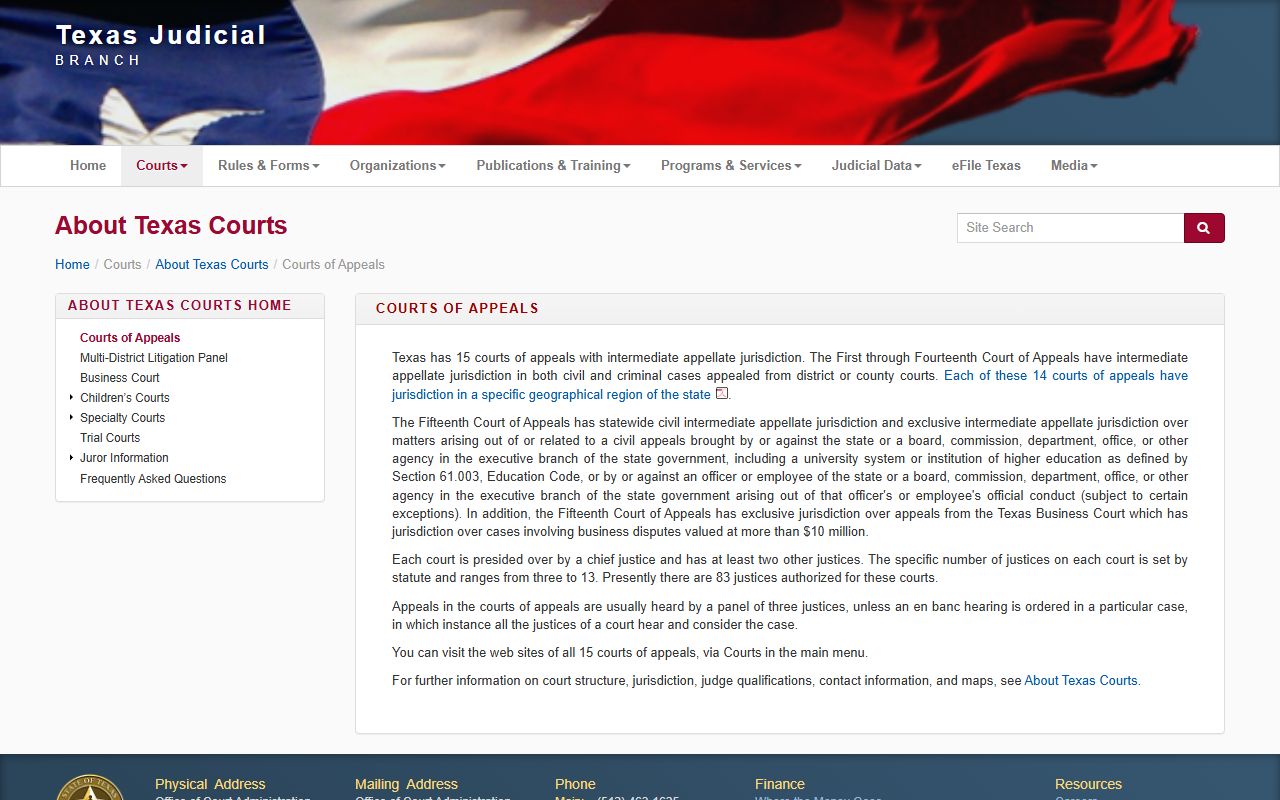
The state describes those intermediate appellate courts on the Texas Courts of Appeals page. From there, civil and juvenile appeals can reach the Supreme Court of Texas, and criminal appeals can reach the Texas Court of Criminal Appeals.
Magistrate and Lower Courts
Hays County's seven Justice of the Peace courts handle magistrate work for arrests, fine-only criminal cases, small civil claims, evictions, and traffic matters. The Criminal Associate Judge in district court also performs magistrate functions for serious cases. Municipal courts in cities such as San Marcos and Kyle handle city-ordinance and Class C cases within their city limits. For the precinct-by-precinct JP details, see the justice courts page, and for the misdemeanor and probate-side courts, see the County Courts at Law page.
The split among district, county-court-at-law, and JP courts is one of the most useful concepts for a Hays County records user. A traffic ticket lives at the JP or the city court. A misdemeanor or probate lives with the County Courts at Law. A felony, a divorce, or a big civil case lives at the district court. Each of these paths has its own clerk, its own portal entry, and its own fee schedule, so picking the right one saves time.
Federal Court Information for Hays County
Hays County sits in the Western District of Texas for federal trial court purposes, and the Austin Division covers the county along with several others. Federal criminal prosecutions, federal-question civil cases, diversity civil cases, habeas matters, and other federal jurisdiction cases are searched through the federal court systems, not the Hays County District Clerk.
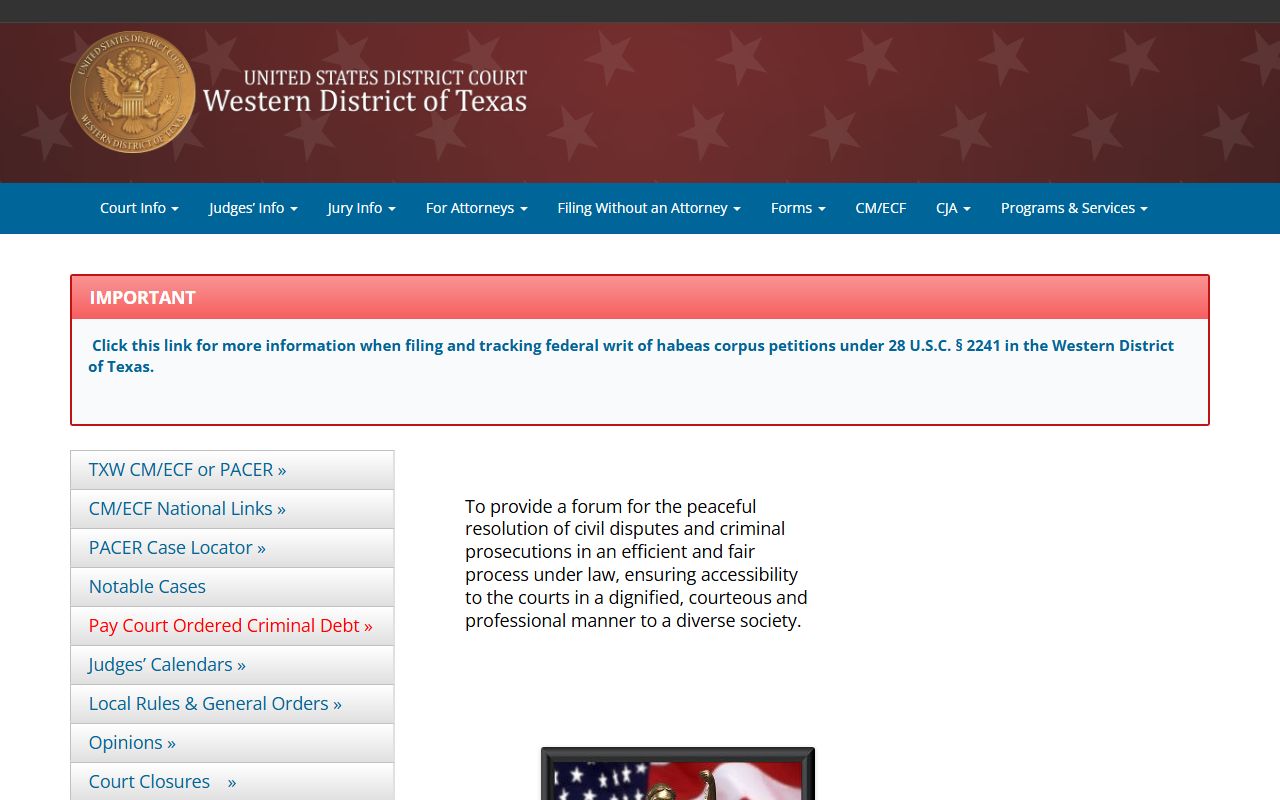
The main page is at the U.S. District Court for the Western District of Texas. Electronic filing and access for attorneys and parties run through CM/ECF.
That system is at the Western District CM/ECF site. Public users search federal dockets through PACER, which charges access fees unless a user qualifies for an exemption or waiver.
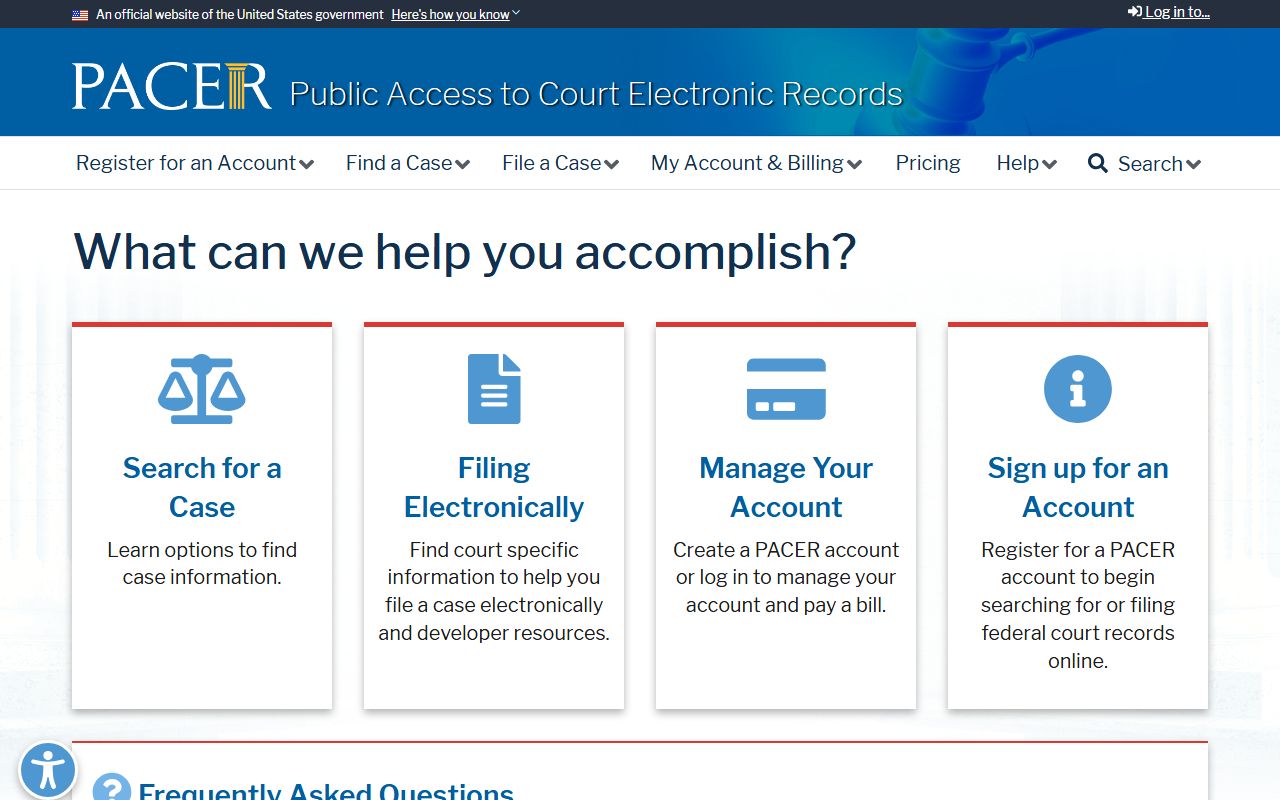
Register and search through PACER. Federal bankruptcy is a separate court, the U.S. Bankruptcy Court for the Western District of Texas.
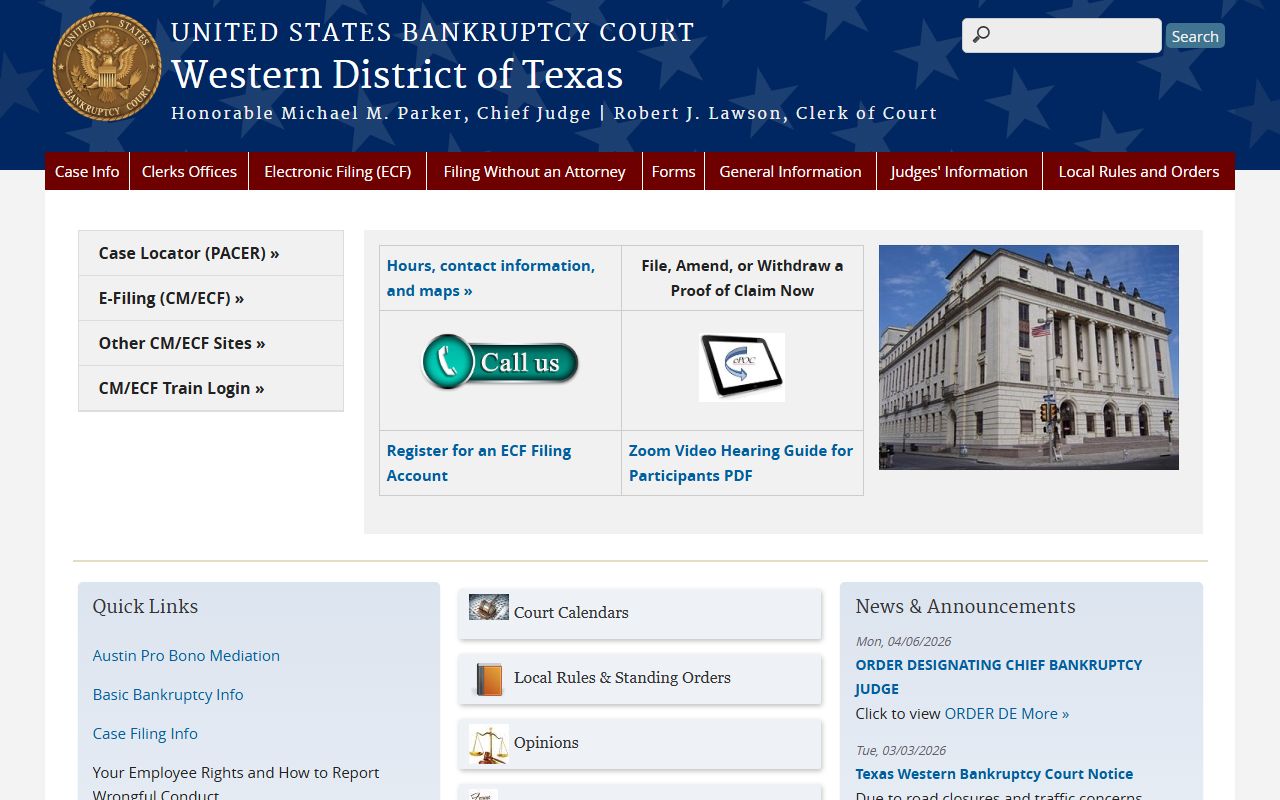
The bankruptcy court sits at the U.S. Bankruptcy Court for the Western District of Texas page. Bankruptcy is a federal court file, not a Hays County District Clerk or County Clerk file. Federal appeals from the Western District go to the U.S. Court of Appeals for the Fifth Circuit.
Read about the appeals court at the Fifth Circuit site.
The U.S. Marshals Service for the Western District of Texas covers Hays County for federal warrants and prisoner transport. The Hays County Sheriff's Office and the San Marcos Police Department are listed as members of the Lone Star Fugitive Task Force. Federal criminal prosecution comes from the U.S. Attorney's Office for the Western District of Texas, whose Austin Office handles many Hays County matters.
One practical note. A federal case search is not a substitute for a Hays County district court search. The systems are separate, the indexes do not cross-reference, and PACER charges fees that the Hays County free portal does not. So a complete picture often needs both, with each system searched on its own terms.