
Arrest Records in Hays County
Arrest records are made by law enforcement, not by the courts. In Hays County, the Sheriff's Office books people into the county jail at 1307 Uhland Road in San Marcos. City police departments make arrests too, but anyone held in the county jail shows up in the Sheriff's booking data. An arrest record marks the booking event: the name, the charge at booking, the booking number, and the dates.
An arrest record is not the same as a criminal court record, and neither one proves guilt. Once a prosecutor files charges, the case opens a court file with its own cause number and docket. The Hays County Criminal District Attorney prosecutes those cases. For the full case history, charges, pleas, and disposition, use the Hays County court records page; this page focuses on the arrest itself.
The booking process sets a few things in motion. After arrest, a person is taken to the county jail, identified, and booked. A magistrate then reviews the case, sets bond or conditions, and tells the person the charges. Texas Code of Criminal Procedure Chapter 17 governs bail, and Chapter 15 governs the arrest warrant behind many bookings. Bond can be a cash or surety bond through a bail bond company, or a personal bond based on a written promise. The jail bond search lists the bond company when a surety is involved, which is why arrest data and bond data sit side by side in the same system.
The Criminal District Attorney's office, shown here, handles felony and misdemeanor prosecution and lists its divisions.
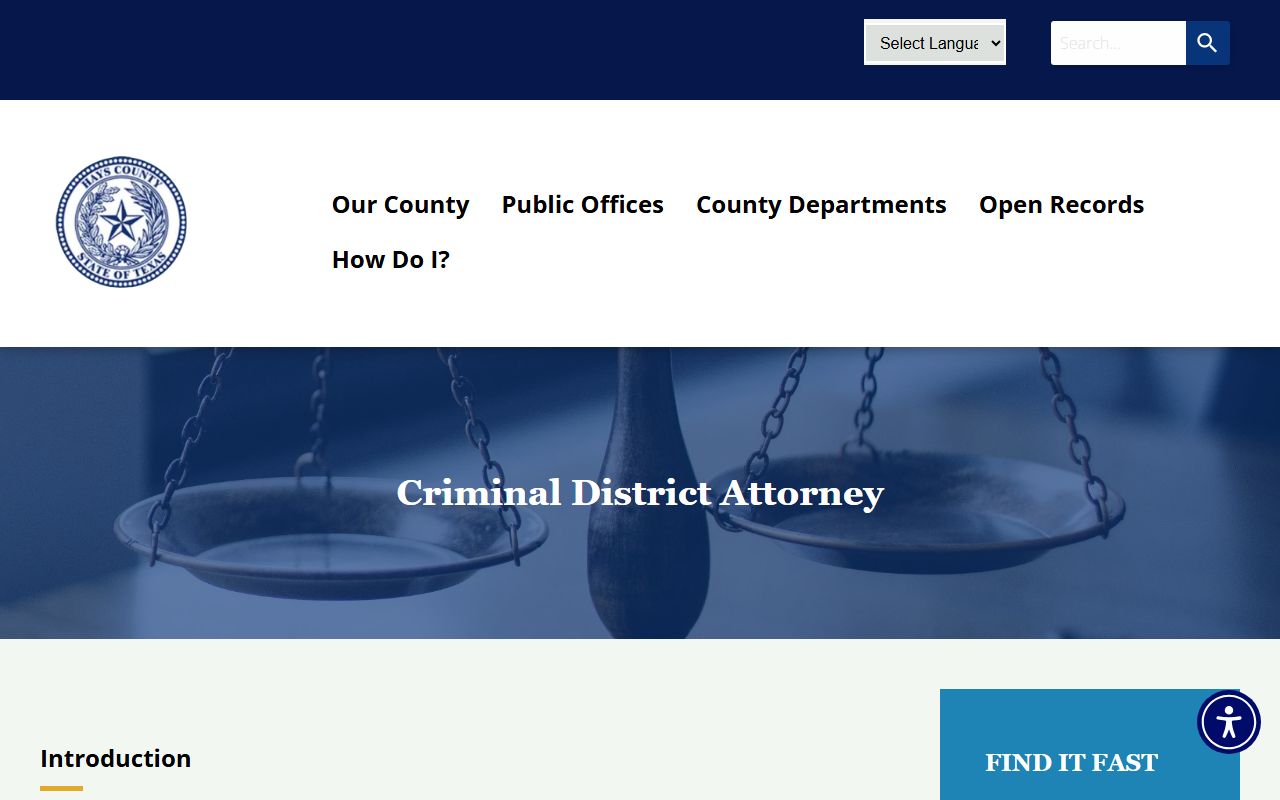
You can review its divisions on the Criminal District Attorney page.
How to Search Hays County Arrest Records
The fastest path to a recent booking is the county's Odyssey Jail Records search. It is free, and it does not ask you to log in. You can search by defendant name or by booking number. The Sheriff's Office page also links crime reports and a jail population dashboard, which help you see broader trends rather than one person.
- Open the Odyssey Jail Records search.
- Choose to search by Defendant or by Booking Number.
- Enter a last name and first name, or the booking number.
- Add a booking date range to find recent arrests, then open the result.
For the charge and case outcome, switch to the criminal case search instead, since that is where filed charges and dispositions live. To confirm whether someone is still in custody, call Jail Records at 512-393-7832. See the Hays County inmate records page for the full roster walkthrough.
What a Hays County Arrest Record Shows
The jail search form is built around a small set of fields, and those fields shape what you get back. You can search by defendant or by booking number, and you can filter by booking and release date ranges. That tells you the record is keyed to the booking event, not to the full criminal history.
From the official search fields, a public arrest or jail record in Hays County can include the items below.
- Booking number assigned at intake
- Defendant name and date of birth
- Booking date and, when it applies, release date
- Bond status, listed as open or closed
- Charge at booking, with the bond company on a jail bond search
Be careful about what the record does not promise. The captured search did not return a full profile, so do not assume housing unit, medical flags, or a charge-level history are public. The arrest record is a snapshot of the booking, and it is public information rather than a complete background report.
Arrest Records vs. Criminal Court Records
The two records start at different points and live with different offices. The arrest record begins at booking and sits with the Sheriff. The court record begins when a prosecutor files charges and sits with the clerk. One does not replace the other.
| Arrest Record | Criminal Court Record | |
|---|---|---|
| Source | Sheriff or police | District or County Clerk |
| Created When | At booking | When charges are filed |
| Contents | Booking number, charge, dates, bond | Pleadings, motions, plea, disposition |
Charges vs. Convictions
Being charged is not the same as being convicted. A charge is an accusation. A conviction is a finding of guilt by plea or verdict. The standard of proof is far higher for a conviction. So an arrest with a charge listed says nothing final about guilt.
| Charge | Conviction | |
|---|---|---|
| Stage | Accusation at or after arrest | Guilty plea or verdict |
| Burden of Proof | Probable cause | Beyond a reasonable doubt |
| Outcome | Case still open | Sentence or judgment entered |
Texas also uses deferred adjudication, where a judge holds off on a finding while conditions are met. That is not a conviction, and a finished deferred case may be dismissed.
Sealed vs. Expunged Records
Texas gives two main ways to limit access to a criminal record. They are not the same. An expunction destroys eligible records and lets a person deny the arrest. An order of nondisclosure, sometimes loosely called sealing, hides eligible records from most public searches but keeps them for certain criminal justice uses. A civil court file may also be sealed by court order.
| Sealed / Nondisclosure | Expunged | |
|---|---|---|
| Visibility | Hidden from most public searches | Destroyed; treated as if it never happened |
| Law Enforcement | Still available for some uses | Very limited access |
| Texas Law | Government Code Chapter 411 | Code of Criminal Procedure Chapter 55 |
Eligibility is technical. The expunction statute and the nondisclosure statute set the rules, and the District Clerk posts expunction and nondisclosure forms. Many people use the State Law Library guide or an attorney before they file.
Mugshots and Booking Photos
A mugshot is the booking photo taken when a person is processed into the jail. In Texas, booking photos held by a law enforcement agency are often public, but the county's online jail search does not promise a public mugshot gallery, and the captured search form centers on names, booking numbers, and dates. Treat any mugshot you find with care. It records an arrest, not a conviction, and the case may have ended in dismissal. Avoid third-party mugshot sites, which often charge to remove images and repackage public data.
Statewide and Federal Criminal Records
A county search only shows Hays County. For a wider check, Texas keeps criminal history record information under Government Code Chapter 411, run by the Department of Public Safety. That state system reaches beyond one county. Federal charges are different again. They are prosecuted by the U.S. Attorney's Office for the Western District of Texas and searched through the federal court system, not the county portal.
The U.S. Attorney's Office for the Western District of Texas, shown here, covers Hays County for federal matters.
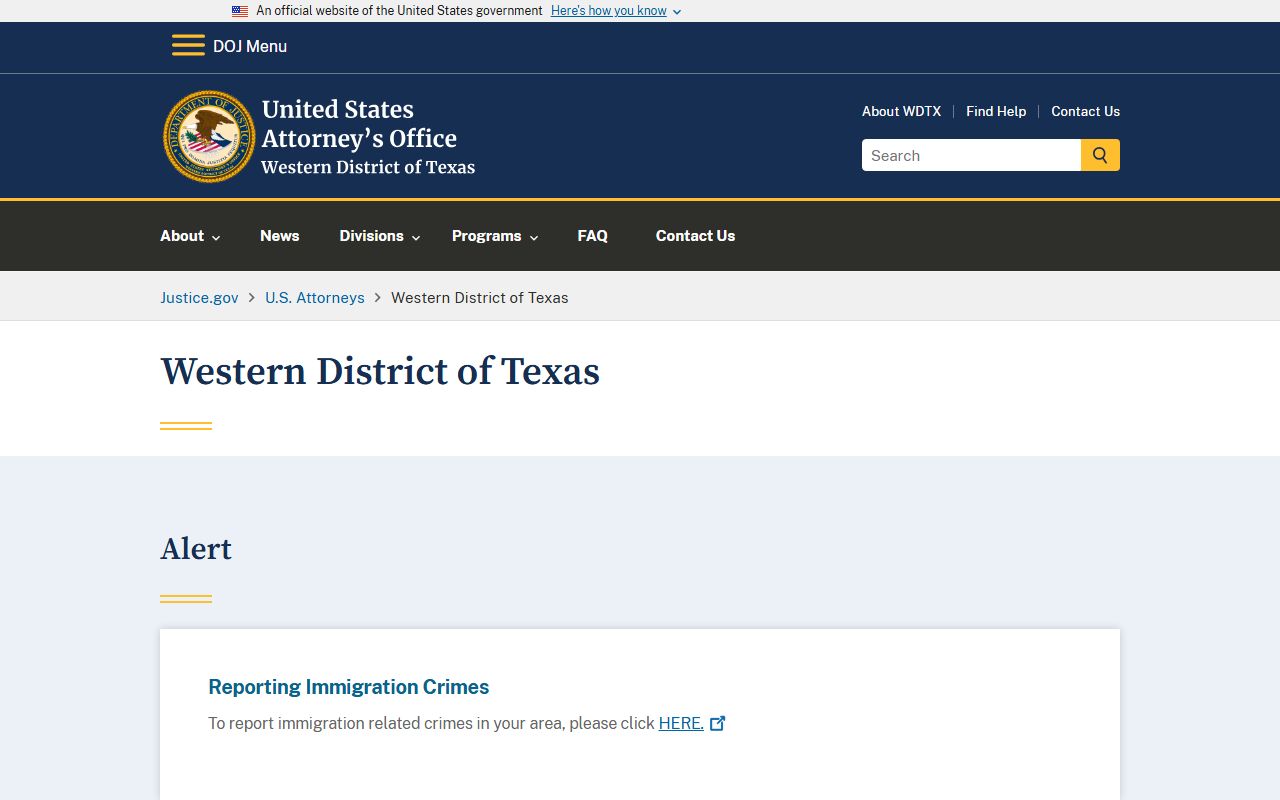
You can read about its work on the U.S. Attorney's Office page. Federal case files are searched through PACER, covered on the district court page.
There is also a public registry to know about. The Texas Department of Public Safety runs the state sex offender registry, which lets the public search by name and location for people required to register. It is separate from a routine arrest search, and it is updated as offenders report. For a person already sentenced to state prison, the Texas Department of Criminal Justice runs its own inmate search. Both of those tools, plus the federal Bureau of Prisons locator, are covered on the released inmates and inmate records pages.
Background Check Considerations
There is a difference between a casual records lookup and a formal background check. A formal check used for hiring, housing, or credit must follow the federal Fair Credit Reporting Act and use a licensed agency. A free county search is fine for personal knowledge, but it is not a compliant background check and may miss sealed, expunged, or out-of-county records.
Important: This site is not a consumer reporting agency under the FCRA, and its information may not be used for employment, tenant, credit, or insurance decisions.
Restricted Criminal Records in Hays County
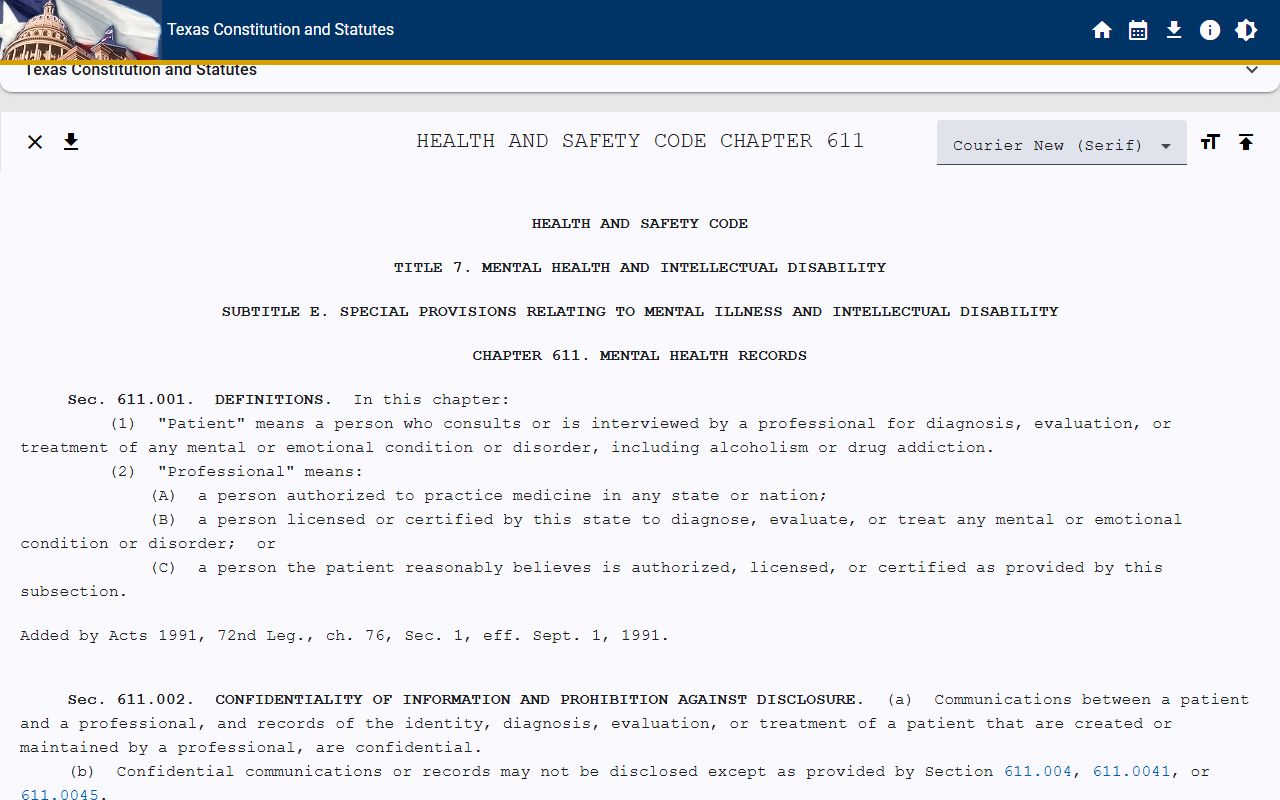
Several kinds of criminal records are kept from the public docket. Juvenile records are limited under Texas Family Code Chapter 58 and are not handled like adult arrests. Adoption files tied to a case are confidential under Family Code Chapter 162. Mental health records are protected under Health and Safety Code Chapter 611. Active investigations and certain law enforcement material may be withheld under the Public Information Act.
The juvenile records law, shown here, sharply limits who may see a youth's record.
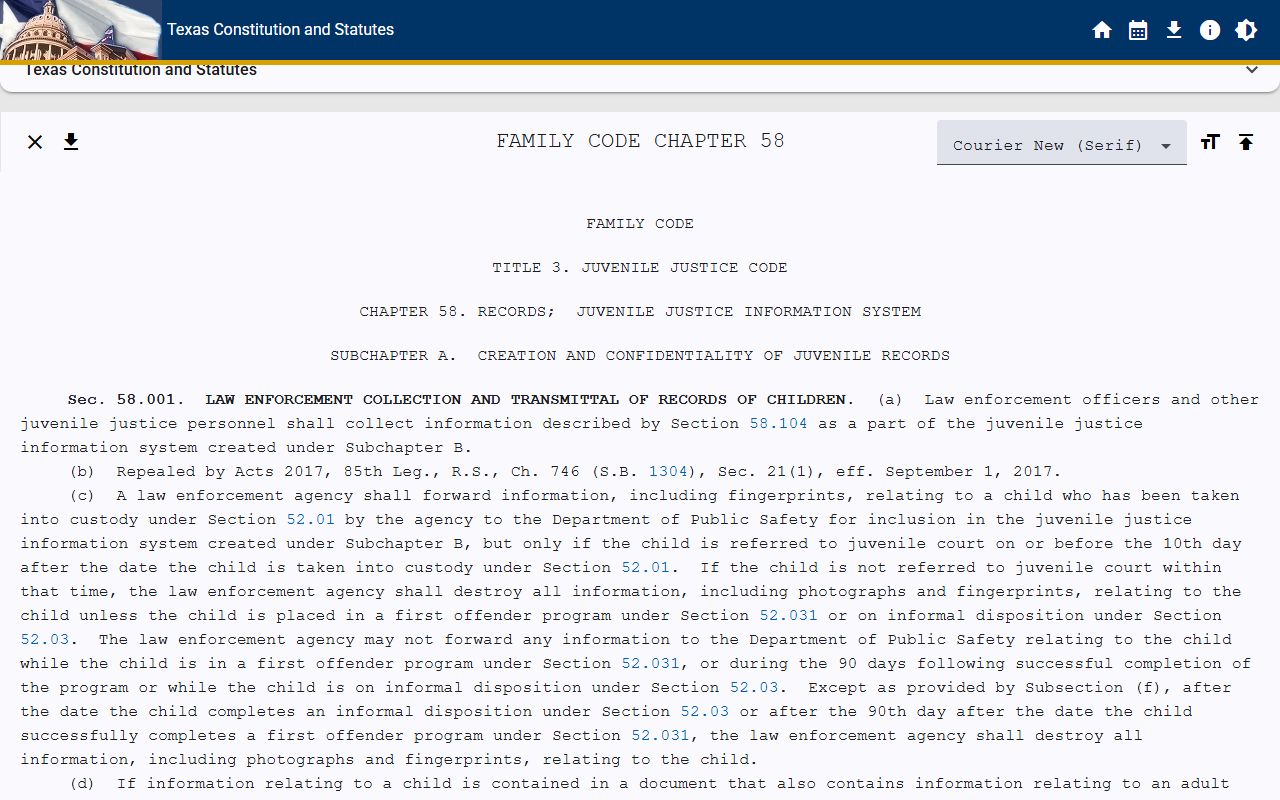
You can read it at Family Code Chapter 58. Adoption confidentiality is set by Chapter 162.
The adoption confidentiality law is shown below.
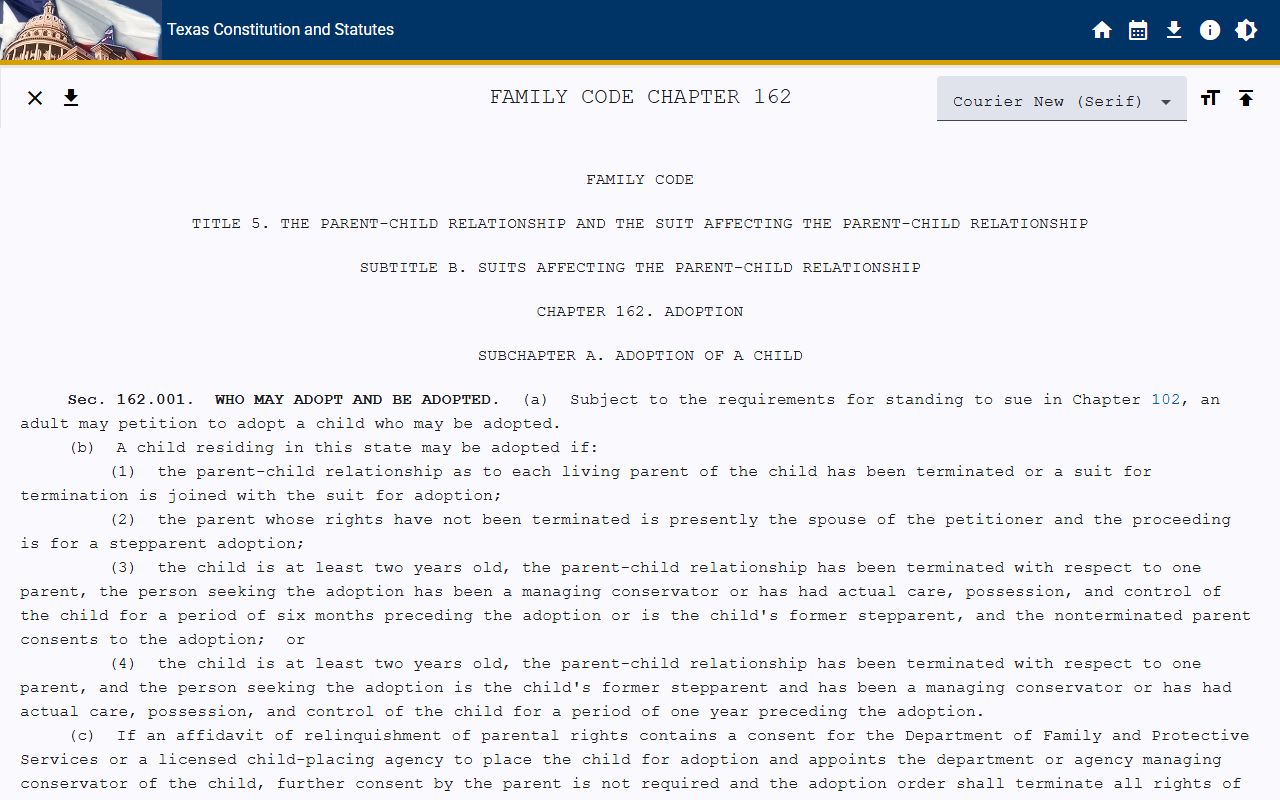
Mental health record protection sits in Health and Safety Code Chapter 611, shown here.
Because these limits are strict, a clean public search does not always mean a clean record.